
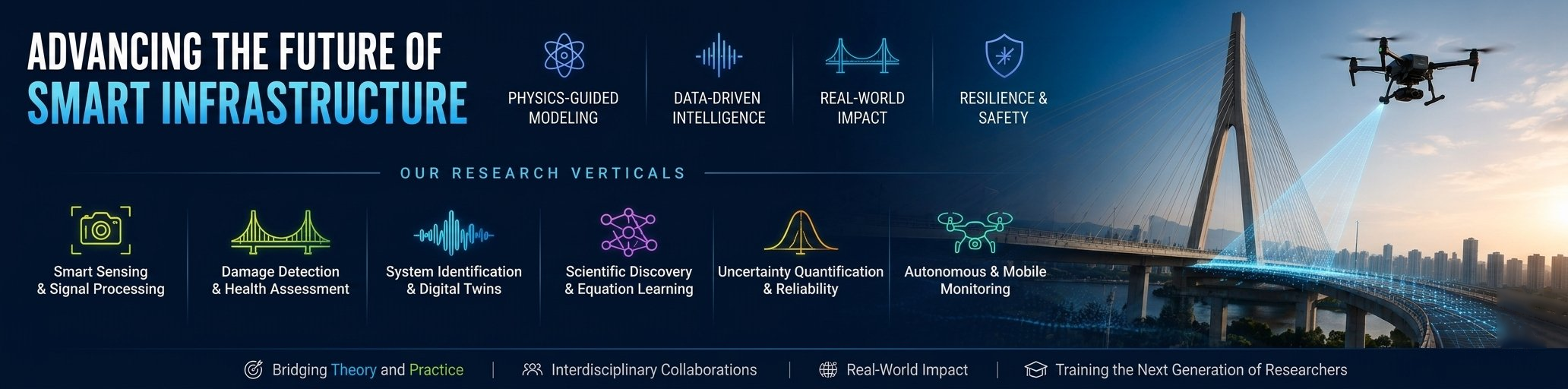
Prospective Students: I am looking for motivated PhD, M.Tech, and B.Tech students interested in smart infrastructure, physics-guided sensing, structural health monitoring, computer vision, AI/ML, digital twins, and infrastructure resilience.
RISE Lab#
Resilient Infrastructure and Smart Engineering Lab#
Led by Prof. Ashish Pal
Department of Civil Engineering
Indian Institute of Technology Bombay
RISE Lab develops machine learning, computer vision, physics-guided sensing, and digital-twin methods for health monitoring, prognosis, and decision support in civil infrastructure systems.
The long-term goal is to enable smart and resilient infrastructure that can sense, interpret, predict, and support maintenance decisions using data, sensing technologies, structural mechanics, and machine intelligence.
Core Areas#
Smart Infrastructure Physics-Guided Sensing Structural Health Monitoring Computer Vision and AI Digital Twins Infrastructure Prognosis and Resilience
Research Vision#
Sense#
Develop sensing and signal-processing methods to extract reliable structural response from cameras, accelerometers, strain sensors, drones, and heterogeneous field measurements.
Interpret#
Use physics-informed AI and scientific machine learning to identify structural behavior, detect damage, and discover governing patterns from measured data.
Predict#
Build digital twins and computational models that can update with data, quantify uncertainty, and forecast infrastructure performance.
Decide#
Support inspection, maintenance, and resilience decisions through interpretable models, uncertainty-aware diagnosis, and engineering judgment.
Featured Publications#
Sparse PDE Discovery for Nonlinear Dynamic Systems#
Physics-informed AI and machine learning for discovering governing equations from dynamic response data.
Sparse Identification of Nonlinear Dynamic Systems#
A sparsity-promoting system identification framework using unscented Kalman filtering, selective thresholding, and model selection.
Data Fusion for Structural Response Estimation#
Kalman-filter-based fusion of intermittent displacement and acceleration measurements for high-fidelity structural sensing.
Current Research Directions#
Physics-Informed AI for SHM#
Develop AI/ML models that combine structural dynamics, sensing data, and physical principles for reliable damage detection, health monitoring, and condition assessment.
Digital Twins for Civil Infrastructure#
Create computational twins of bridges and building frames by integrating finite element models, sensing data, state estimation, and machine learning.
Vision-Based Infrastructure Monitoring#
Use cameras, drones, and computer vision to measure vibration, displacement, cracks, and visible damage in civil infrastructure systems.
Join the Group#
Students interested in PhD, M.Tech thesis, or B.Tech research projects in smart infrastructure, physics-guided sensing, structural health monitoring, computer vision, AI/ML, digital twins, prognosis, and infrastructure resilience are encouraged to get in touch.